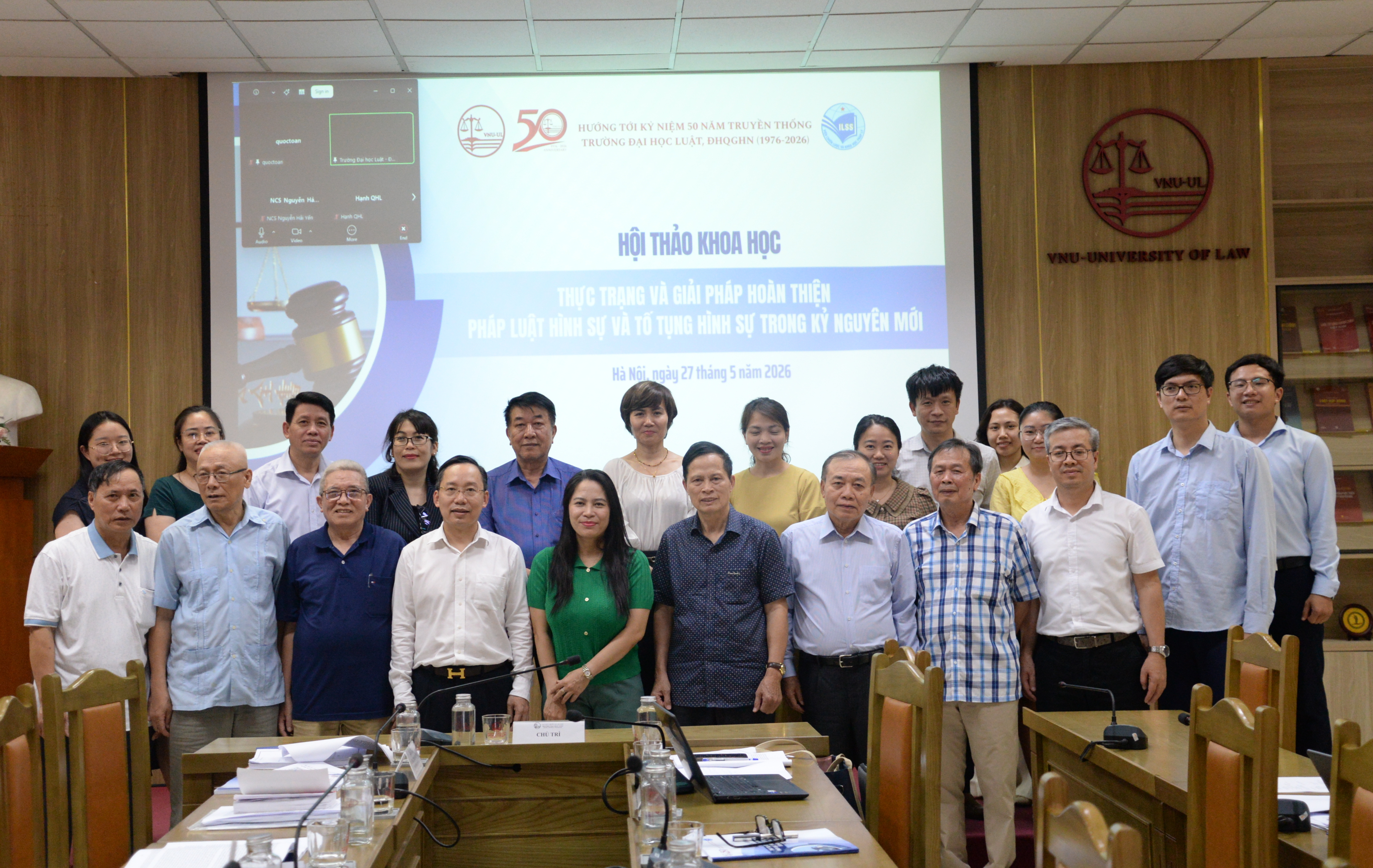


As Vietnam enters a new period of development requiring the continued building of a socialist rule-of-law state, reviewing and improving criminal law and criminal procedure law has become a pressing task, both in theory and in practice. To draw on legal and interdisciplinary expertise for the Ministry of Justice’s project “Strategy for Improving Vietnam’s Legal System in the New Era,” VNU University of Law, together with the Institute of Legal Strategy and Science, Ministry of Justice, held a workshop on 27 May 2026 titled “Current Status and Solutions for Improving Criminal Law and Criminal Procedure Law in the New Era.”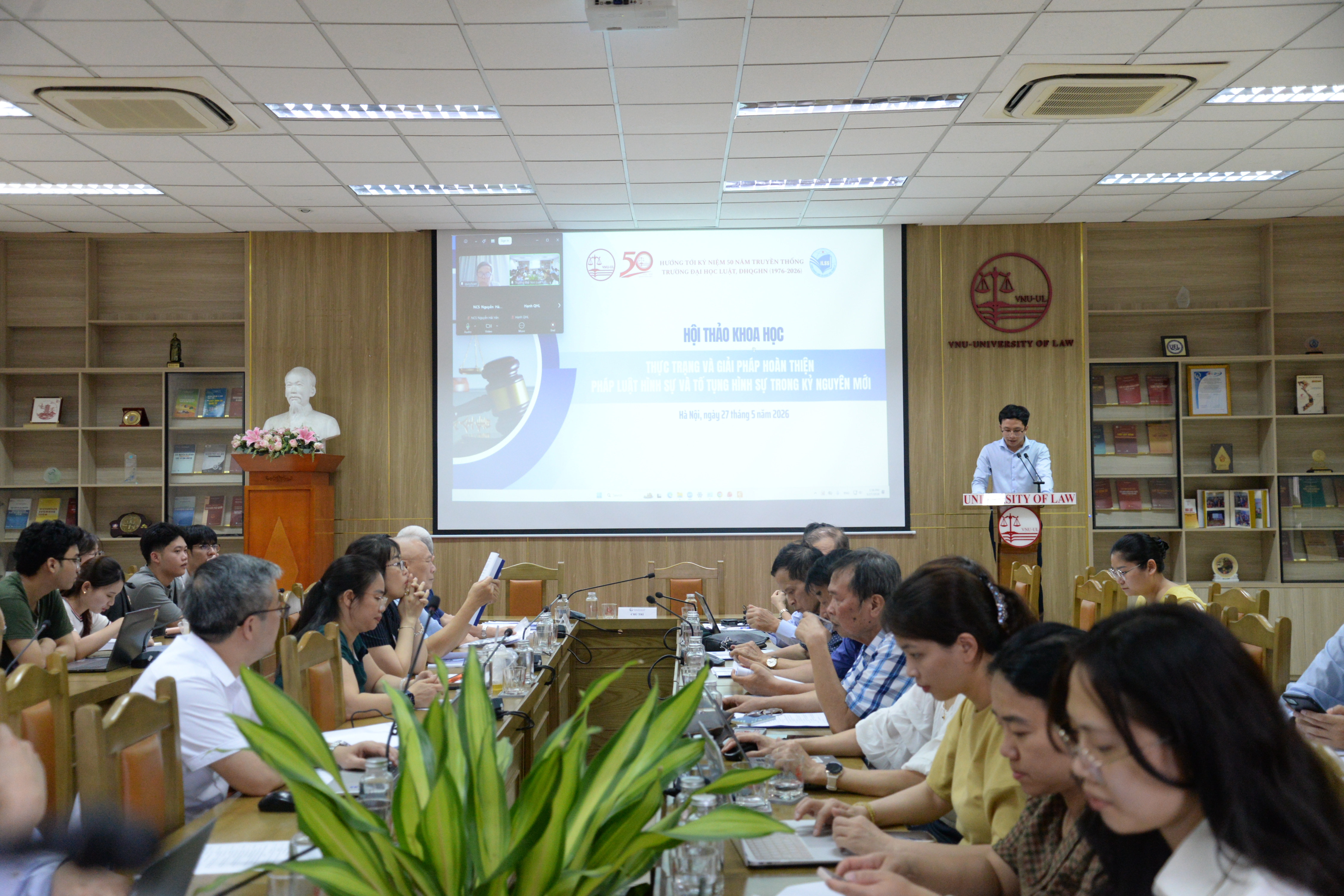
The workshop drew a large number of scholars, legal experts, representatives of law training institutions and practical agencies, along with lecturers, graduate students, PhD candidates and students interested in criminal justice. In his opening remarks, Assoc. Prof. Dr. Trinh Tien Viet, Acting Rector of VNU University of Law, spoke about the need to rethink criminal legislation and criminal procedure amid digital transformation, deepening international integration, and the need for stronger protection of human and civil rights within a modern rule-of-law state. 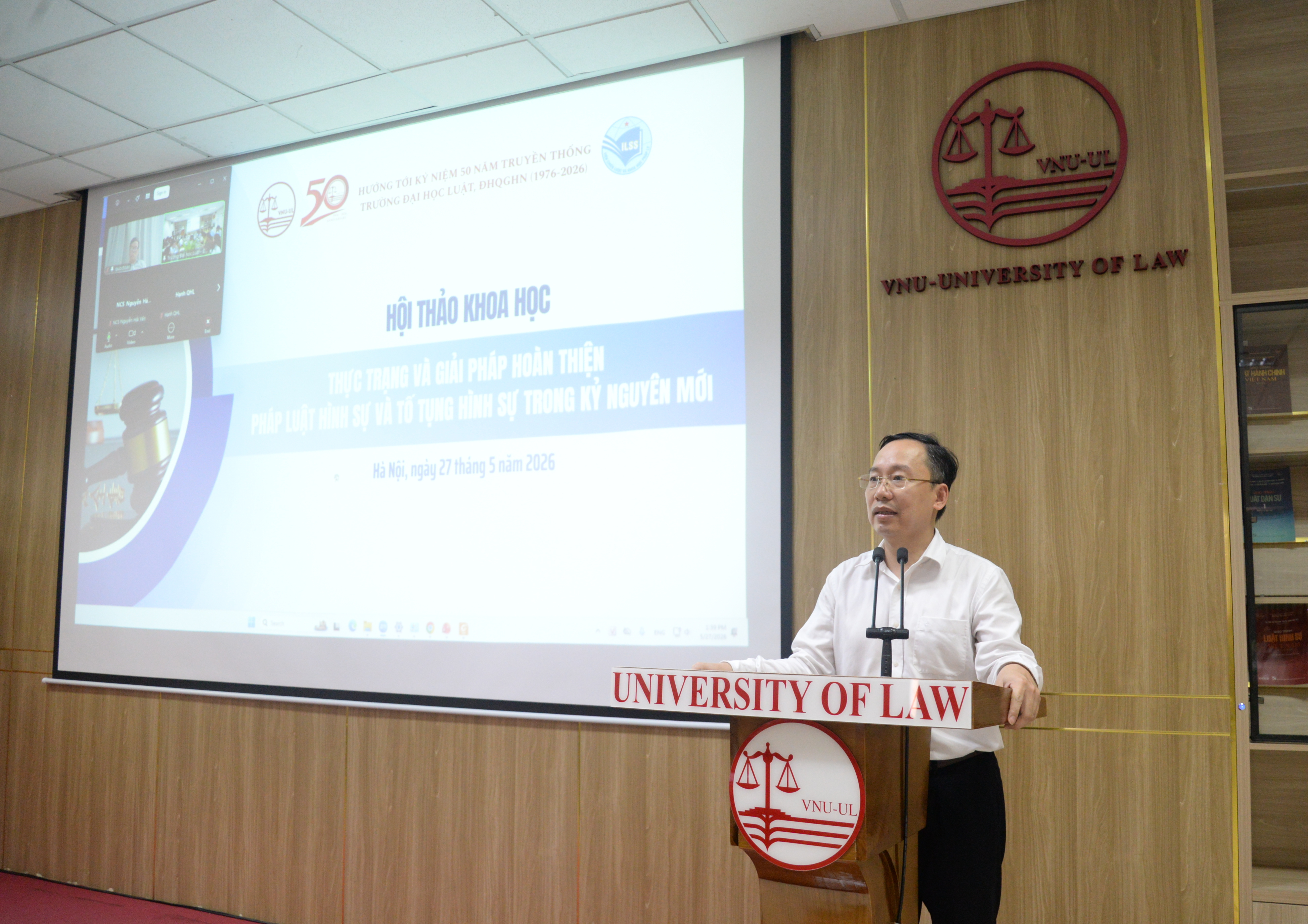
The workshop featured seven papers across two main sessions.
Session 1: Current status and solutions for improving criminal law
Prof. Dr. Sc. Le Van Cam, former Dean of the School of Law, VNU, opened the session with a paper titled “Current Status of the General Part of the Current Penal Code and Proposals for Further Improvement.” The paper examined weaknesses connected to the provisions of 6 of the 9 major institutions in the General Part of the 2015 Penal Code, and proposed new provisions and improvements to the General Part to ensure the consistency, transparency and workability of Vietnamese criminal law in the new period.
Assoc. Prof. Dr. Trinh Tien Viet followed with “Current Status of the Penal Code: Shortcomings and Proposals for Amendment.” The paper assessed specific provisions, identified inconsistencies in the underlying legislative philosophy and principles, and pointed to other issues and shortcomings, offering the drafting committee a further reference point for review and amendment as part of institutionalizing Party policy on crime prevention and meeting practical needs under the new phase of building Vietnam’s socialist rule-of-law state.
On the protection of human rights, Dr. Nguyen Mai Bo presented “Protecting Personal Rights through Criminal Law: Current Status and Directions for Improvement,” examining the current provisions on offenses that directly violate personal rights and proposing improvements to strengthen the protection of life, health, honor and dignity under criminal law.
Assoc. Prof. Dr. Trinh Quoc Toan presented “Protecting the Property Rights of Individuals and Businesses through Criminal Law: Current Status and Directions for Improvement,” analyzing current criminal policy and the provisions of the 2015 Penal Code on protecting property rights, and identifying limitations in Vietnamese criminal law amid the growth of the digital economy and international integration. The paper proposed directions for reform, including strengthening crime prevention, expanding the use of non-custodial measures, improving asset recovery, refining the criminal liability regime for legal entities, and adding mechanisms to address new forms of property-rights violations arising in the digital environment.
Session 2: Current status and solutions for improving criminal procedure law
The second session addressed theoretical and practical issues in current criminal procedure law.
In “Criminal Procedure Policy and the Continued Improvement of the Current Criminal Procedure Code,” Assoc. Prof. Dr. Nguyen Ngoc Chi and Dr. Tran Thu Hanh examined criminal procedure policy as part of broader criminal policy, guiding efforts to prevent and combat crime and to protect justice, human rights and legal order in the new period. The paper proposed distinguishing procedural roles based on three core functions — prosecution, defense and adjudication — to ensure an adversarial process, equality between parties, and the central role of the courts, along with judicial independence, stronger protection of human rights, more effective legal defense, and limits on the misuse of preventive measures, as key directions for ongoing judicial reform.
Assoc. Prof. Dr. Le Lan Chi presented “On the Subjects of Criminal Procedure and Issues for Improving Criminal Procedure Law,” taking a systemic approach to procedure-conducting agencies, authorized officials and participants in proceedings. The paper identified issues requiring further attention, including the division of authority among procedure-conducting agencies, ensuring accountability for protecting the rights of participants, and reforming the procedural model to strengthen the central role of the courts and equality between parties.
Closing the session, Assoc. Prof. Dr. Le Huynh Tan Duy presented “Classifying Procedural Types and the Economic Problem Facing Vietnam’s Criminal Procedure Law,” offering a law-and-economics perspective. The paper examined a “resource paradox,” in which the number of criminal cases continues to rise while judicial resources remain limited, and proposed streamlining and differentiating procedures and expanding the use of electronic proceedings. It emphasized the need for diversion mechanisms, such as guilty pleas, sentence agreements, and conditional deferral or exemption from criminal liability, to ease the burden on the justice system and support reintegration.
Discussion
Following the presentations, scholars, experts and practitioners took part in an active discussion, focusing on new demands facing criminal law and criminal procedure amid digital transformation, globalization, the rise of high-tech crime, and the need for stronger protection of human and civil rights.
Several participants said that amending the Penal Code and the Criminal Procedure Code should be approached comprehensively and coherently, balancing the need to prevent and combat crime with the protection of justice and human rights and the promotion of sustainable economic and social development.
In closing, the organizing committee said the papers and discussion at the workshop provided an important source of material with both theoretical and practical value, contributing to the research, drafting and improvement of Vietnam’s criminal law and criminal procedure law in the new era.